

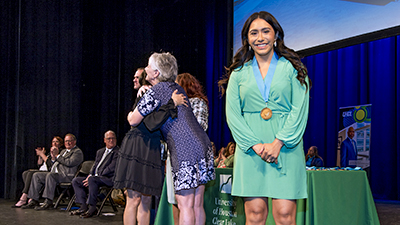

Faculty Spotlight: Dr. Giazu Enciso Domínguez, College of Human Sciences and Humanities
Students stand in line outside of an office to talk with Dr. Giazú Enciso Domínguez, assistant professor of critical social psychology. She is running late for a meeting on the first floor of the Bayou Building on UHCL’s main campus, but students always take precedence. As she finishes talking with one, a group of students comes down the stairs. They see her standing outside of the office. They stop to talk with her as well.
Some of these students are asking for explanations of a lesson they just discussed in class, but some of them are just wanting to talk with her about her research, their research, their lives or any number of things.
“She does genuinely care about the students and wants to provide them opportunities,” said Dr. Chris Ward, professor and department chair of the department of psychological and nursing sciences. “And as far as what I can see, the students, it comes across to them, and they see that also.”
Anyone who is watching the scene outside of the office might say the same thing as students continue to flock toward Dr. Enciso Domínguez on the first floor of the Bayou Building, asking questions, seeking feedback and connection. The students do understand that she wants them to succeed not only in her classes, but in life beyond the classroom.
“Everything she does is student-focused,” Dr. Ward said. “She is very mindful of what is best for the students, giving them opportunities, bringing people from other universities here, giving students opportunities to study abroad. She wants to be able to have these kinds of experiences, especially experiences that maybe not all students at a smaller university like this have.”
When Dr. Enciso Domínguez arrived at UHCL, she arrived without physically seeing the university or visiting with faculty in person. It was the COVID pandemic, and she interviewed virtually.
“Bringing in somebody that we hadn’t really met and they hadn’t really met us was unusual,” Dr. Ward said. “But when she arrived, she came in so excited about everything. She just had all of the ideas in the world.”
But for Dr. Enciso Domínguez, it seemed to be love at first sight, throwing herself into the life of the university and the community, bouncing ideas off of Dr. Ward for research, classes and grants while also going out to recruit students into the department when there were recruiting fairs.
“She is just a good department citizen,” Dr. Ward said. “This kind of speaks to her desire to help students. Her being bilingual, that helps her talk sometimes to family members who are at recruiting fairs. She thinks that’s important to be able to have someone who can talk to the family in their own language.”
Outside of her department, Dr. Enciso Domínguez coordinates on projects with Dr. Roberta Leal, associate professor of social work, that focus on her passion of social psychology and Dr. Leal’s passion for social work.
“The way we overlap is in our desire and our passion to work in community with larger groups and to study and research groups of people and behavior and how different people are interacting with each other all within the context of society,” Dr. Leal said.
The duo has coordinated with non-profit organizations as part of their research and community service, helping gather toys for children and scheduling game nights for adults while listening for ways to be helpful. But Dr. Leal’s work with Dr. Enciso Domínguez goes beyond their shared community service. Dr. Leal has been in the audience as Dr. Enciso Domínguez presented research with a student.
“You could tell that the student was excited and felt welcomed by Dr. Enciso Domínguez and felt comfortable sharing what they had learned from their professor, and so it was really neat to be in the audience,” Dr. Leal said. “She is very enthusiastic about student learning and building that professional relationship in the classroom.”
That enthusiasm for teaching started at a young age when young Giazú helped her mom cook and “taught” imaginary people how to cook the dishes they were making.
“When I was a kid when my mom used to cook with me, we were preparing stuff,” she said, “and I always asked in advance what are we going to do? Then I put it on a tiny board, and then I explain and teach people how to cook. I explained that because I really wanted to teach classes. Maybe I was super annoying. I don’t know how my mom survived.
“That’s my heart,” she said. “I always wanted to learn and pass the learning and teach and learn, so yes. That is the heart, and I am still passionate about that.”
But since those days of “teaching” cooking in her parent’s house in Puebla, Mexico, another passion has emerged: Research, which has also ignited a passion in Dr. Enciso Domínguez that she wants to share with students.
“I tell my students to choose a topic that you’re truly passionate about because you’re going to spend a lot of time trying to understand and reading about the topic,” she said. “I tell them you have to breathe your topic. You have to wake up thinking about your topic. You go to your Instagram, and you’re going to see reels about your topic or something that has nothing to do with your topic, but you manage to connect it.”
That focus on getting students interested in and acculturated to research extends beyond the classroom to Dr. Enciso Domínguez’s lab, the Critical Interdisciplinary Studies Lab or CIS, which includes UHCL undergraduate and graduate students and other students from around the world. It has been active since 2017.
“I try to promote a really horizontal approach where the students also have input and have peer-to-peer feedback, peer-to-peer writing, reviewing, and they research whatever they want,” she said. “The only conditions are that it should be critical, so questions power. We do qualitative research, and you have to go back to the community that generously gave you the data the majority of the time for free—their time, their knowledge, their expertise.”
Some of the products students in the lab have produced include presentations, papers and workshops, but Dr. Enciso Domínguez believes some of the most exciting products have been the ones that create an impact on the communities and sometimes healing through comic books and letters that transform into shared narratives.
“I think those are the highlights of my research lab, because that goes beyond academia, but it’s bringing people back to academia,” she said. “It’s not just a paper. It’s something that anyone can read. Anyone can understand, so you can make sense of what we do among these walls.”
These are the types of connections that Dr. Enciso Domínguez is best at—putting ideas together, putting people together and creating a community in her lab, among her colleagues at UHCL as well as in her classrooms, which is why students flock around her.
“I do love to teach,” Dr. Enciso Domínguez said, “and I love to teach about research. I tell my students to use me as a resource; ask me questions because I’m here for you.”
And that was exactly why Dr. Enciso Domínguez was surrounded by students in the hallway outside of the office in the Bayou Building. They were asking her questions. Trying to get the answers to help them understand the research. Trying to get feedback on their ideas. And just wanting to get to know the woman whose family nicknamed her “Gato,” the word for male cat in Spanish, who is allergic to cats, plays the accordion, speaks three languages but understands five, is currently learning two more, and teaches their classes at UHCL.
“I love being an international scholar trained in different countries and regions, but grounded in Texas,” Dr. Enciso Domínguez said. “I feel like I ended up exactly in the right place. I decided I wanted to live in Texas, at this university, with these students. I am happy and proud to serve them.”

